
Learning Unknowing
Belief at the edge of mystery

“Try to love the questions themselves… Live the questions now.” --Rainer Maria Rilke
Arrival
Christine, a dear friend to this day, and I arrived in Port-au-Prince, Haiti, on May 6, 1991. Christine was from Australia.
We were picked up at the airport and driven two hours west to Léogâne, where we settled into a small house that would be home on and off for the next several months. Running water and electricity were intermittent. At the time, those absences felt like inconveniences. I didn’t yet understand how formative they would become.
The poverty, noise, and smells, the suffering, crushed in on our psyches. Years later, a woman visiting from the US would describe passing through Port-au-Prince as “an affront to my senses.” I understood exactly what she meant.
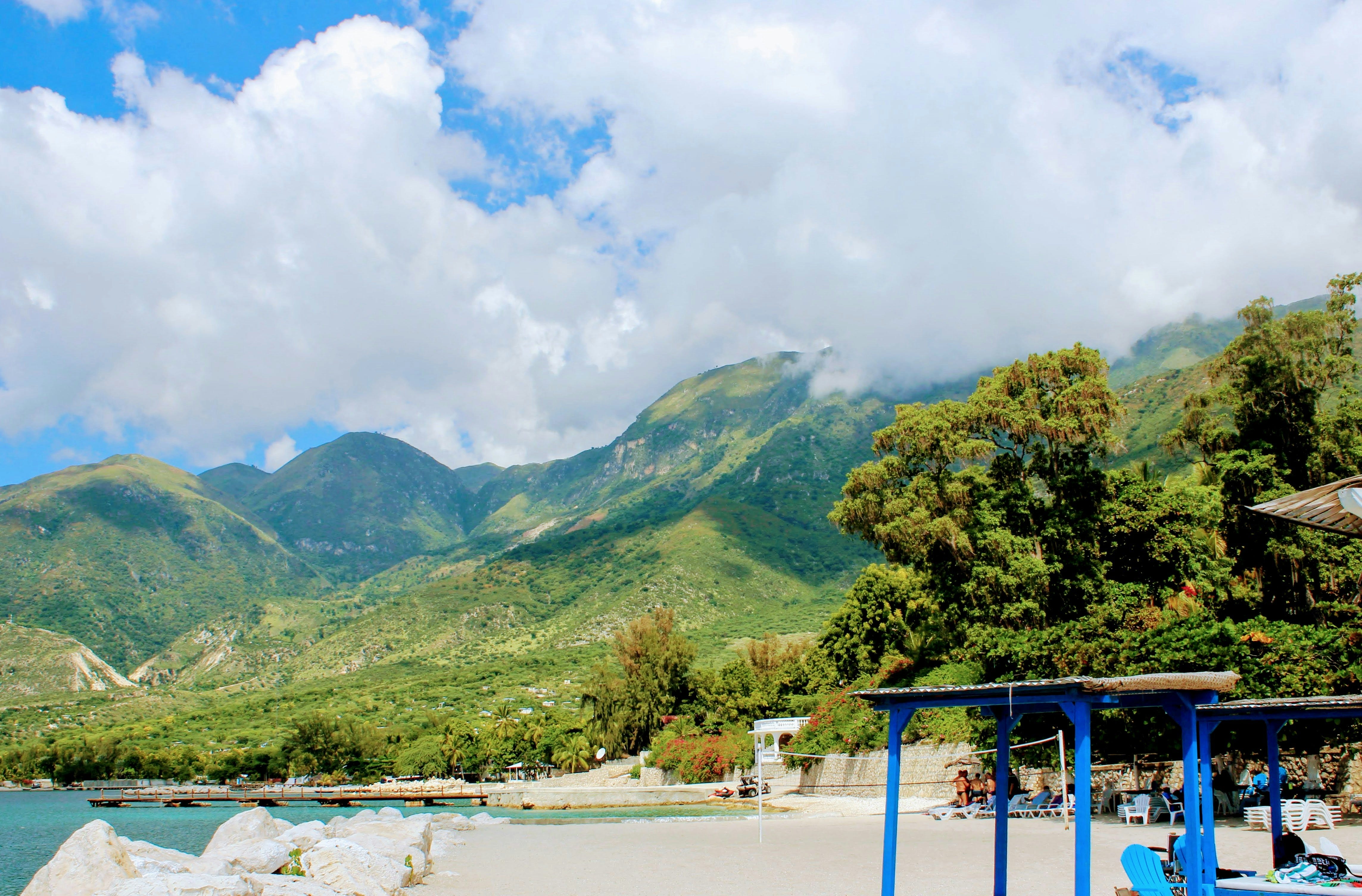
And yet Haiti was also, from the very first day, breathtaking.
The mountains rise spectacularly from the coast, lush and dramatic, cascading down toward beaches of white sand and turquoise Caribbean water so clear it seems lit from within. The plains spread wide and green. Port-au-Prince itself holds surprising architectural beauty. The famous gingerbread houses, ornate Victorian structures built by Haitian craftsmen in the late 1800s, their fretwork and turrets somehow still standing amid the chaos of the city. The streets pulse with color, with music, with the smell of street food and the sound of Haitian Creole rising and falling like song.
Haiti is a place of stunning, almost defiant beauty. And in much of its urban landscape, that beauty is increasingly smothered by poverty, by plastic waste, by crumbling infrastructure, by the accumulated weight of generations of extraction and misrule.
Christine and I were learning, from those very first days, to hold both at once. The magnificence and the suffering. The laughter and the grief. The extraordinary resilience of a people and the extraordinary weight they carried.
This is Haiti.
Katrina, the twenty-three-year-old American woman responsible for picking us up at the airport, hosting us where she lived, and orienting us, was warm, generous, and visibly tired, wise and mature beyond her years. She could do everything: navigate Haiti’s roads, cook local dishes, put nervous newcomers at ease. But what struck me most was her command of Haitian Creole. She had lived in the country just over a year, yet spoke the language with an ease that signaled respect rather than performance. Katrina and I have remained great friends ever since.
Katrina arranged for Christine and me to meet with a number of wise and compassionate people known for their work among the poor. What we learned from them would help ground us in the country we had come to serve. Some were Haitians. Some were Americans who had lived in Haiti for decades. One of them was Father Roger Desir.
Pè Desir
Father Desir, Pè Desir as everyone called him, was an Anglican priest and brilliant Haitian linguist who had studied in the United States and then returned to Haiti to serve his people. He was a fierce champion of Haitian Creole, a language that belonged to every Haitian, yet one the educated world, in Haiti and abroad, had long refused to take seriously. Pè Desir played a key role in translating the Bible into written Haitian Creole, a project that took well over ten years. The completed Bible, known as Bib La, was published in 1985. It was an extraordinary feat that empowered millions of people.
It was only in the 1970s and 80s that significant progress was made in standardizing Haitian Creole’s written form. The Constitution of 1987 finally recognized it as an official language alongside French. And yet to this day it remains stigmatized as the language of the poor and uneducated. A Haitian who walks into a bank in Haiti will be addressed in French, even when it’s clear they don’t speak it. Only an estimated 5 to 10 percent of Haitians speak fluent French. The rest are expected to manage in a language that was never truly theirs.
We met at Pè Desir’s home on Delmas 47, in a neighborhood of the same name within Port-au-Prince. When we arrived, he pulled out several locally made steel chairs and arranged them in a loose circle on the porch. They were simple and sturdy.
We drank rich, dark Haitian coffee, heavily sweetened, the Haitian way. As we sat, the air carried the aroma of corn cobs roasting on open grills along the street. Cars and tap-taps, small covered brightly painted pick-ups packed with people paying for transportation, passed in front of the house, their engines and voices rising and fading. A wall and a metal gate enclosed their property, as was common for those with the means to secure it.
Pè Desir himself exuded graciousness. His features were beautiful, his eyes warm. A gentle smile was never far from his face, and he laughed easily, without pretense.
The Questions That Stayed
At one point, he began to talk about the questions that had surfaced for him as a student.
“Why am I taught that it is better to like apples, which are not grown in Haiti, than mangoes, which are plentiful and far tastier? Why am I punished in school when speaking Haitian Creole at recess and taught that French is a superior language? Why did I witness teachers allowing light-skinned students to get away with things the dark black students could not?”
He didn’t speak with anger. He spoke with curiosity. With puzzlement. These were not accusations. They were honest questions that stayed with him.
Listening to him, I realized I was being introduced not only to Haiti’s history, but to the long afterlife of colonization and slavery, how power embeds itself in language, in taste, in education, and in what children are taught to admire or feel ashamed of.
I was beginning to understand how a society learns to doubt itself.
But sitting with Pè Desir that afternoon, I began to ask a deeper question: where does the impulse toward superiority come from in the first place?
At its root, colonialism rests on two beliefs: that I am superior to you, and that my superiority gives me the right to exploit you. Sometimes this is wrapped in religious language. God has entrusted me with resources and capabilities, and I bear a responsibility to steward them for the advancement of my people. The violence is baptized. The exploitation becomes duty.
James Baldwin pointed to something few people want to examine. “What white people have to do,” he wrote, “is try and find out in their own hearts why it was necessary to have a ‘n*****’ in the first place, because I’m not a ‘n*****’, I’m a man. But if you think I’m a ‘n*****’, it means you need him.”
Baldwin was pointing to a profound truth: the need to diminish another often reveals a wound in the one doing the diminishing. By ranking someone below me, I temporarily escape my own self-doubt. I borrow worth I don’t feel I possess.
It may often be unconscious and not personal. Perhaps this ranking is simply cultural, so deeply embedded in the world around us that we absorb it before we think to question it. We compare and rank because almost everyone around us does. The hierarchy feels like reality rather than a choice.
This matters because those underlying forces did not disappear when colonialism became lost ground and began to become taboo. They live on in how we relate with others: as tourists, neighbors, managers, and colleagues. As countries in relationship with other countries. Until we understand the roots of the impulse toward superiority, we will keep reproducing it in ways that we’re unable to see.
Pè Desir had spent a lifetime asking exactly these questions and had devoted himself to answering them through action.
He had devoted his life to a conviction: that every person is a child of God, deserving of dignity, and that society and its institutions should reinforce rather than undermine that truth. He shared with countless linguists the belief that language is too often used to establish hierarchy, to mark some people as educated and others as lesser, to shame those who had fewer opportunities. He believed that no human being should ever feel ashamed of their mother tongue. And that a mother tongue, to fully serve its people, must be written so that it can become a living tool for communication, learning, and progress.
Over centuries, humanity has come to organize much of its shared life around the written word, its laws, its commerce, its education, its memory. To read and write is to be included in that life. When a person’s mother tongue has never been written down, they are not simply illiterate. They are told, in a thousand silent ways, that their language and therefore they themselves do not fully count.
Years later, that truth would arrive with startling force.
No matter how much we tried to help non-literate Haitians recognize the immense knowledge and wisdom they already possessed, we consistently heard the same thing at graduations, adults learning to read and write in Haitian Creole for the first time, sometimes with tears in their eyes:
“I’m now a person. Prior to this, I knew nothing.”
Kounye a, mwen se yon moun. Avan, mwen pa t konn anyen.
The words never stopped breaking my heart. Pè Desir had understood that colonization’s deepest wound is not poverty. It is the theft of a person’s belief in their own worth. He gave his life to doing something about it.
The Ground Beneath Me
The understanding that I was awakening to did not come without cost. Being immersed in another culture gives you distance from your own. That distance can be unsettling. For the first time, I began examining the culture I had grown up in, the United States, through a different lens. Faith. Politics. Race. Power. Assumptions I had never questioned before.
The ground beneath me was feeling a bit unstable.
I had not yet understood that Haiti would be the place where many of my inherited certainties would begin to loosen.
That afternoon on Pè Desir’s porch, something in me cracked open, not dramatically, not all at once, but enough to let doubt and humility enter together. I was reflecting on his words and on the intense poverty and injustice I was witnessing and learning about.
Was my faith grounded in reality? How could a loving God allow such terrible suffering, for centuries? And why did the faith of people living in such poverty and hardship put mine, comfortable, cushioned, largely untested, to shame?
I was losing my confidence that I understood what faith was.
The Prayer
As the conversation slowed, the afternoon light shifted. The street noises continued their steady rhythm beyond the wall and gate, but the circle had grown quiet.
Pè Desir looked at Christine and me for a moment, then asked gently if he could pray with us.
We nodded.
He bowed his head slightly and began.
He prayed for our safety. He prayed for open ears and open hearts. He prayed that we would learn to walk humbly among the people we had come to serve.
Then he prayed for Haiti.
He prayed for the empowerment of the Haitian people. For dignity. For wisdom. For courage. For the ability to name what had been done to them without being consumed by it. For strength to build a future not dictated by the wounds of the past.
As he prayed, I became aware of something subtle but important: he did not ask God to fix everything. He did not offer easy answers. He did not explain suffering.
He entrusted it.
When he finished, there was a brief silence. No one rushed to fill it.
We sat there together, coffee cups empty, the bustling sounds of the street and the smell of roasted corn drifting in, and I felt something settle in me. Not certainty. Not clarity.
But reverence.
The Beginning of Learning Unknowing
That afternoon on Pè Desir’s porch, I didn’t lose my faith.
But I did begin to loosen my grip on the belief that faith was about understanding.
I began to sense that it might be about posture instead. About listening. About standing in the presence of mystery without demanding it explain itself.
It would take me years to find the language for what was happening. Some of it still eludes me.
But that prayer, and those first bewildering, humbling weeks in Haiti, marked the beginning.
The beginning of learning unknowing.
I carry these questions with me still. I offer them to you as companions for the road.
Where in my life have I inherited a hierarchy I never chose and never questioned?
What would it mean to sit with someone whose life looks nothing like mine, and simply listen?
And what might begin to loosen in me, if I let it?
John, thank you for taking us with you to your early days in Haiti. I am sitting with these nuggets from your beautiful piece:
“…where does the impulse toward superiority come from in the first place?
“Until we understand the roots of the impulse toward superiority, we will keep reproducing it in ways that we’re unable to see.”
“…colonization’s deepest wound is not poverty. It is the theft of a person’s belief in their own worth.”
“…standing in the presence of mystery without demanding it explain itself.”
What a breathtakingly beautiful reflection John. The questions you name, the grace with which you hold them, the sense of invitation to others implicit in your inquiries. Thank you!